
"INTERNATIONAL"
-
Use of EJU Scores by Universities and other Schools | JASSO
universities or other schools that do not require applicants to take EJU as part of their admissions process? Q. What is meant by “using EJU” by Japanese universities and other schools? A. “Using EJU” refers to the use by Japanese universities of EJU scores in their screening of international students for admission. More specifically, Japanese universities contact JASSO to learn EJU scores of individuals seeking admission to their schools, and utilize those scores as selection references. Please be aware, however, some institutions don’t rely only on EJU scores but also use its own entrance exam and/or an
-
Scoring, etc. | JASSO
this, score equating is used to adjust for the difficulty levels between different versions of EJU. Score Equating is also applied to indicate the results of the Japanese-Language Proficiency Test, as well as those for the Test of English as a Foreign Language (TOEFL), the Test of English as International Communication (TOEIC) and other tests designed to measure English language skills. For further details, please refer to the link below. Score Equating Q. EJU is also offered outside of Japan. Are the same test questions used in all overseas venues? A. No, not all test questions are the
-
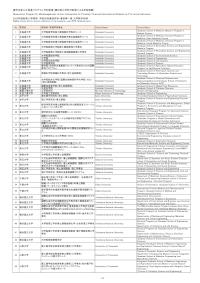
Reservation Program for Monbukagakusho Honors Scholarship for Privately-Financed International Students by Pre-arrival Admission Eligible school list for Autumn admission in the academic year 2025: Graduate level
Reservation Program for Monbukagakusho Honors Scholarship for Privately-Financed International Students by Pre-arrival Admission Eligible school list for Autumn admission in the academic year 2025: Graduate level 留学生受入れ促進プログラム予約制度(渡日前入学許可制度による学校推薦) 2025年度秋季入学採用学校別対象研究科・専攻等一覧大学院予約枠 Eligible school list for autumn admission in the academic year 2025:
-
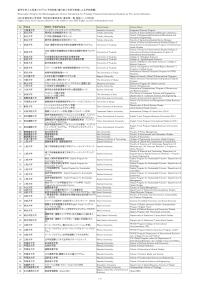
Reservation Program for Monbukagakusho Honors Scholarship for Privately-Financed International Students by Pre-arrival Admission Eligible school list for Autumn admission in the academic year 2025: English courses (Undergraduate level)
Reservation Program for Monbukagakusho Honors Scholarship for Privately-Financed International Students by Pre-arrival Admission Eligible school list for Autumn admission in the academic year 2025: English courses (Undergraduate level) 留学生受入れ促進プログラム予約制度(渡日前入学許可制度による学校推薦) 2025年度秋季入学採用学校別対象研究科・専攻等一覧英語コース予約枠 Eligible school list for autumn admission in
-
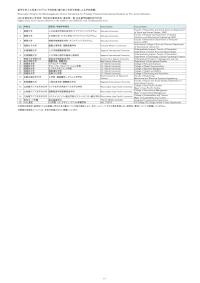
Reservation Program for Monbukagakusho Honors Scholarship for Privately-Financed International Students by Pre-arrival Admission Eligible school list for Autumn admission in the academic year 2025: EJU exam (Undergraduate level)
Reservation Program for Monbukagakusho Honors Scholarship for Privately-Financed International Students by Pre-arrival Admission Eligible school list for Autumn admission in the academic year 2025: EJU exam (Undergraduate level) 留学生受入れ促進プログラム予約制度(渡日前入学許可制度による学校推薦) 2025年度秋季入学採用学校別対象研究科・専攻等一覧日本留学試験利用予約枠 Eligible school list for
-

The 78th TIEC Research and Presentation Poster
Gropus Inc. by Japan Student Services Organization. 参加費無料 Participation fee free What is MY STUDY? 会場:東京国際交流館プラザ平成 3 階メディアホール Venue : Tokyo International Exchange Center Plaza Heisei, 3F Media Hall 日英同時通訳あり Simultaneous interpretation is available in Japanese and English. 13:00 13:20 受付 Registration 13:20 13:25 機構による開会挨拶 Opening Remarks 13:25 14:55 プレゼンテ
-
Social Finance | JASSO
(Loan Syndications and Trading Association) with the aim of fostering the development of social loan products while maintaining the flexibility of the loan products. The Social Bond is a bond issued to raise funds for projects that help to resolve social issues (Social Projects), as defined by the ICMA (International Capital Market Association) in its Social Bond Principles, and are bonds targeted for ESG investment*3. *3 ESG investment refers to investment that focuses specifically on Environmental, Social and Governance factors. The Social Loan is a loan issued to raise funds for projects that help to resolve social issues (
-
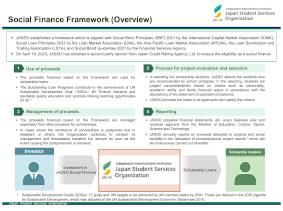
Social Finance Framework(Overview)
Social Finance Framework(Overview) Japan student services organization JASSO established a framework which is aligned with Social Bond Principles (SBP) 2021 by the International Capital Market Association (ICMA), Social Loan Principles 2023 by the Loan Market Association (LMA), the Asia Pacific Loan Market Association (APLMA), the Loan Syndication and TradingAssociation (LSTA), andSocial BondGuidelines 2021by the Financial Services Agency. OnApril 14, 2023, JASSOhas obtaineda second party opinion fromJapan Credit Rating Agency, Ltd. to ensure the eligibility as a social finance. Investment in JASSO Social Finance 奨学金の貸与 Scholarship students In selecting the scholarship students,
-
Report on the Use of the Funds and Their Social Impacts(FY2023)
Japan Student Services Organization (hereinafter referred to as“JASSO”) contributes to the achievement of UN Sustainable Development Goal (SDGs) #4“Ensure inclusive and equitable quality education and promote lifelong learning opportunities for all”through its scholarship programs for Japanese students, while working on support programs for international students, which promote international student exchanges, and student support programs, which provide support for career education and job search and for students with disabilities. Under the philosophy of“equal opportunity for education”as stipulated in the Constitution and the Fundamental Law of Education, JASSO provides scholarships for achieving students who find it
-
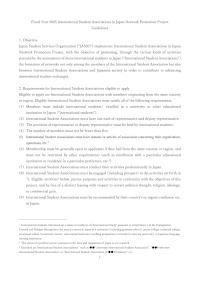
Fiscal Year 2025 International Student Associations in Japan Network Promotion Project Guidelines
Fiscal Year 2025 International Student Associations in Japan Network Promotion Project Guidelines 1 Fiscal Year 2025 International Student Associations in Japan Network Promotion Project Guidelines 1. Objective Japan Student Services Organization ("JASSO") implements International Student Associations in Japan Network Promotion Project, with the objective of promoting, through the various kinds of activities pursued by the associations of those international students in Japan ("International Student Associations"), the formation of networks not only among the members of the International Student Association but also between International Student Associations and Japanese society in order to contribute to advancing international student exchanges. 2. Requirements for

